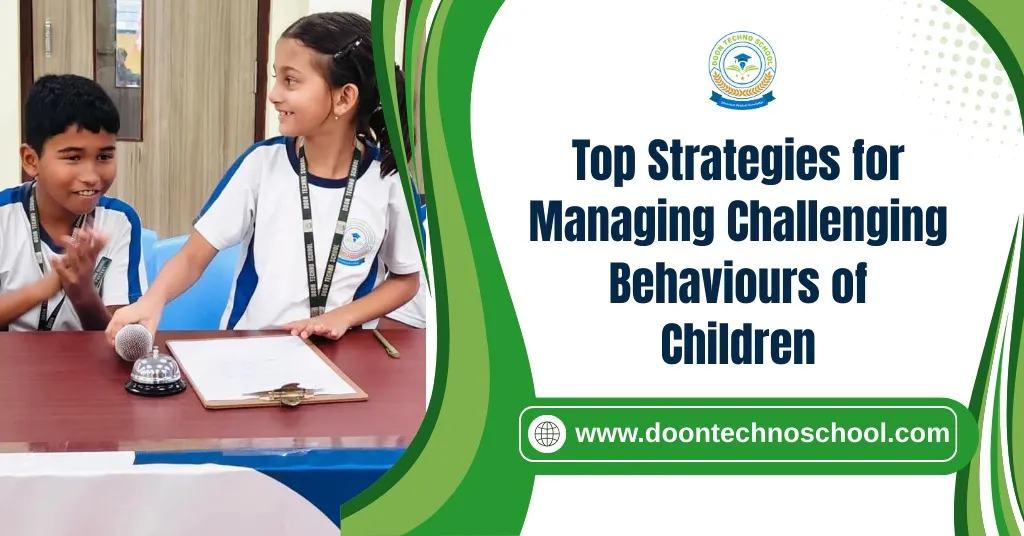
When kids start developing and when they start proceeding towards adulting, many behavioural changes are seen within them. Every child is unique, and so is their behaviour. After parents, teachers are the ones who teaches children about the different behaviours. Schools are the best educational institutions from where child not receives education but also learn about different things.
Doon Techno School is considered as one of the best CBSE school in Howrah, located in Domjur. Our school follows CBSE curriculum and known for providing holistic education to students. Understanding what triggers these behaviours, maintaining patience, and using consistent approaches can help create a positive environment where children learn emotional control, responsibility, and respect.
Below are some of the most effective strategies for managing challenging behaviours in children.
- Understand the root cause of behaviour
- Stay calm and model composure
- Set clear and consistent rules
- Use positive reinforcement
- Teach and encourage emotional regulation
- Establish predictable routine
- Maintain open and supportive communication
- Use natural and logical consequences
Understand the root cause of behaviour
To manage challenging behaviours of children, parents and teachers of Doon Techno School may need to understand the root cause of behaviour. Children sometimes feel anxious or show different kinds of behaviours or moods because of hunger, stress, fatigue and anxiety. Parents should observe the patterns of children, during homework time, after school or when routines change? Parents should identify triggers such as loud environment, conflict with peers. Parents and teachers should even ask questions like – what upset you or How can I help you feel better?
Stay calm and model composure
We all know that children mirror the behaviour of adults. Parents or teachers should always stay calm in front of children. When adults respond with anger, children learn that this is correct way to express frustration.
- Lower your voice instead of raising it.
- Take a deep breath before responding.
- Show your child how to calm down by using relaxation techniques.
A calm adult helps a child feel secure, heard, and more willing to cooperate.
Set clear and consistent rules
Teachers of the best CBSE school in Howrah set clear and consistent rules for children. Teachers and parents may need to keep rules simple and specific, avoid vague instructions like , behave properly, instead, speak softly in the library. When rules are predictable, children feel more in control and less likely to rebel.
Use positive reinforcement
Children respond better to encouragement than criticism. Positive reinforcement helps build confidence and motivates them to repeat good behaviour.
Use:
- Praise (“I’m proud of you for sharing your toys.”)
- Rewards (stickers, extra playtime, Storytime)
- Acknowledgement (“I noticed you tried your best today.”)
Celebrate the smallest improvements—recognition is powerful.
Teach and encourage emotional regulation
Many challenging behaviours stem from children’s inability to control emotions like anger, disappointment, or fear.
Help children by:
- Teaching words to express their feelings (“I am sad”, “I feel angry”)
- Using calm-down corners or breathing exercises
- Engaging in activities like drawing, mindfulness, yoga, and storytelling
When children learn emotional vocabulary and coping strategies, they become more capable of managing their reactions.
Establish predictable routine
Routine provides a sense of stability and reduces behavioural issues caused by uncertainty or unexpected changes.
- Set fixed times for homework, meals, sleep, and play.
- Prepare children in advance for schedule changes.
- Use charts, visual schedules, or reminders.
A predictable day reduces anxiety and problematic reactions.
Maintain open and supportive communication
To manage challenging behaviours in children teachers maintain open and supportive communication. Open communication means listening without interrupting, validating feelings, express thoughts clearly.
Use natural and logical consequences
Punishments may scare children but do not teach responsibility. Instead, use consequences connected to the behaviour.
Examples:
- If a child breaks a toy carelessly, they help fix it or clean up.
- If they spill water intentionally, they wipe it.
This approach teaches accountability in a respectful way.
Conclusion
Managing challenging behaviour in children requires patience, consistency, and empathy. Behaviour is communication—children express their needs, frustrations, and emotions through their actions. When adults respond with understanding, positive reinforcement, and structured guidance, children gradually learn self-control, emotional awareness, and positive social behaviour.Admission Open in cbse school in Howrah is open for sessions 2026-2027.
FAQs:
Q1. What are challenging behaviours in children?
Challenging behaviours include actions such as aggression, defiance, frequent tantrums, lack of attention, or difficulty following rules. These behaviours often reflect underlying emotional or developmental needs.
Q2. Why is it important to address behavioural challenges early?
Early intervention helps children develop emotional regulation, social skills, and positive habits. Addressing behaviours early prevents long-term academic and social difficulties.
Q3. What strategies help manage challenging behaviours effectively?
Positive reinforcement, clear communication, consistent routines, empathy, setting realistic expectations, and encouraging self-expression are effective strategies for behaviour management.
Q4. How does positive reinforcement help children?
Positive reinforcement encourages good behaviour by appreciating efforts rather than punishing mistakes. It builds confidence, motivation, and a sense of responsibility in children.
Q5. What role do teachers play in behaviour management at school?
Teachers act as mentors by creating a structured, supportive environment. At Doon Techno School, educators guide children using patience, clear boundaries, and age-appropriate discipline techniques.
Q6. How can parents and teachers work together to support children?
Regular communication, shared strategies, and consistent expectations at home and school help children feel secure and supported, leading to better behavioural outcomes.
Q7. How does Doon Techno School support children with behavioural challenges?
Doon Techno School focuses on holistic development through value-based education, counseling support, respectful discipline, and child-centric teaching methods.